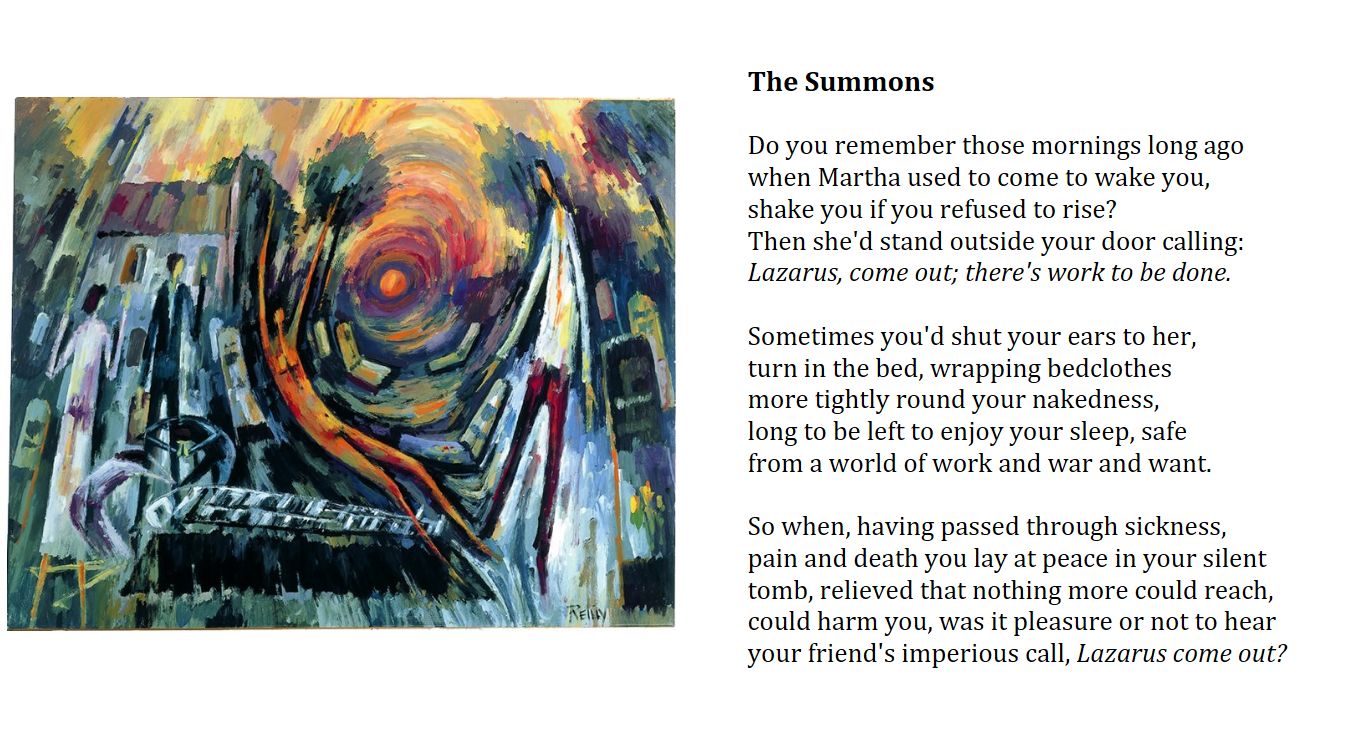
The Raising of Lazarus by John Reilly
John 1132-44
I’ve always wondered whether Lazarus was pleased to be brought back from death, or whether he would have preferred to have been left in peace, safe from the irritations of life and from any future suffering. Perhaps it was exciting, even thrilling, to emerge alive from his grave; but surely it was terrifying, too.
The little crowd gathered around the cave also witnessed something they all knew to be perfectly impossible, and the memory of that day must have haunted them for the rest of their lives. Imagine the silence as the stone was rolled away from the mouth of the grave, no one knowing what was going to happen, or even knowing what to hope for. It was a warm day, but suddenly there was a chill in the air. Did that issue from within the grave? from the fear of death? or did a cloud just pass in front of the sun?
That chill must have affected everyone huddled in the little crowd that day. But for the sisters of Lazarus there were other, more personal, more painful, sisterly emotions.
In Reilly’s painting, Lazarus is stretched out between life and death, a state suggested partly by the colours and the deep perspective and swirling vortex in the picture. Lazarus himself stretches as though being pulled firmly from beyond any normal expectations of reality, leaving his death behind. Maybe there’s even a hint of memories of him being woken by Martha in earlier, happier days, when he stretched out in bed and resisted, for a few precious moments, the challenge of rising to another day.
We stretch our minds, our credibility, as we try to make sense of this extraordinary event. But leaving aside what we do or do not believe, or how we choose to interpret the story, it is worth noting that this miracle is also a metaphor. Jesus is shown as the one who rescues people, calling them out from the darkness of ignorance and sin, and maybe even from death, inviting them to live more fully in the light.
© Alwyn Marriage 2026