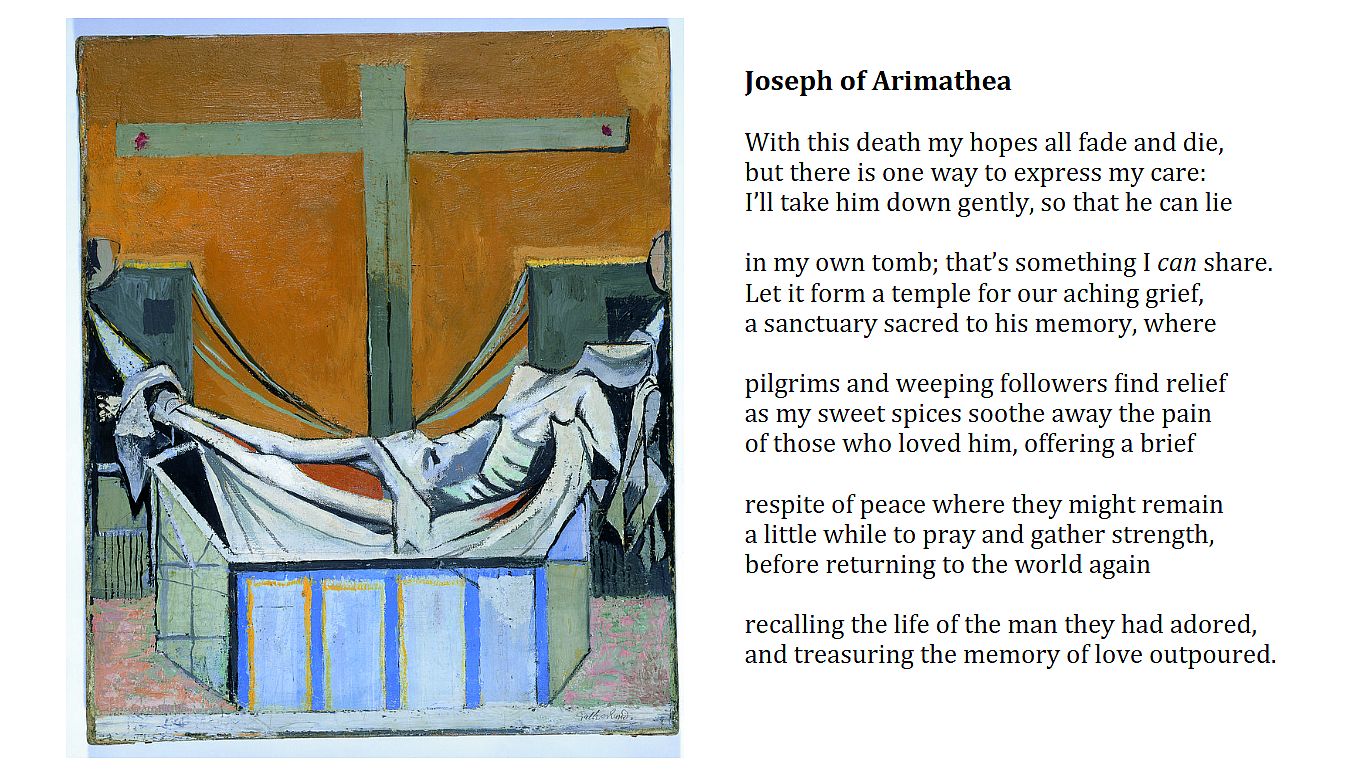
The Deposition by Graham Sutherland
Matthew 27 57-61, Mark 1542-47, Luke 2350-54, John 1938-42
The part played by Joseph of Arimathea following the crucifixion of Jesus appears in all four gospels, with only minor differences. He is described, variously, as ‘a rich man’ (Matthew); ‘a respected member of the council’ who was looking forward to the kingdom of God (Mark); ‘a good and righteous man’ who, while he was a member of the council, had not agreed with the plan to do away with Jesus; and John points out that because of his fear of the Jews, Joseph was a ‘secret disciple’ of Jesus.
In John’s account we read that Nicodemus, the man who had previously come to Jesus under cover of darkness and who was clearly now even more wary of being recognised as one of his followers, accompanied Joseph as together they collected the body of Jesus. They anointed it with spices such as aloes and myrrh and wrapped it in the linen cloth, giving the body the full care appropriate for a Jew, before laying Jesus in a brand new tomb. In this Johannine version, the tomb is in the garden of the place where the crucifixion had taken place, whereas in the synoptic gospels it is described as Joseph’s own unused tomb.
In Sutherland’s oil painting, the body of Jesus is mutilated and broken, but still appears too large to fit in the tomb, suggesting that death could not contain him. The linen winding sheet, or shroud, in which Jesus will be wrapped, follows the shape of his body and bears more than a passing resemblance to the linen draped beneath the body of Christ in Caravaggio’s Deposition, painted in the early 17th century.
In both works, the sheet hangs rather like a hammock below Christ and separates his body from the grave, with the difference that in Caravaggio’s painting the light reflects off the startling white of the shroud. In Sutherland’s image the tomb appears to be surprisingly insubstantial and although we can see only the front of the tomb, it looks as though the box-like structure is hexagonal or octagonal, either of which would be a strange shape for a tomb. There is certainly no suggestion here that the tomb is hewn out of rock, and maybe the hint of a temporary structure suggests that the place of death will soon became the arena for resurrection.
The idea of a high-ranking member of the Jewish council taking down the dead body, removing it to a safer place and preparing it for a dignified burial is deeply moving. Dealing with dead bodies, particularly one that has suffered such torture, is horrible and grotesque, and yet this grief-stricken man treats the mutilated body of Jesus with love, respect and tenderness.
Is it because of Joseph’s secrecy in the gospel story that so many legends have grown up around his life and character? This man, who makes such a brief appearance in the gospels, has certainly inspired a number of imaginative tales, some of which may have some slight basis in reality, while others are too far-fetched to be worth considering. However, while these stories almost certainly lack historicity, it may be worth considering what lies behind them.
In one popular story, the tin merchant, Joseph of Arimathea, brought his teenaged nephew, Jesus, to Cornwall when he visited in the course of his work. In another, the cup (or possibly the plate) that was used at the Last Supper was transported to Britain and somehow ended up in Glastonbury. In a slightly different version, found in the work of the mediaeval French poet Robert de Boron, the cup was the vessel in which Joseph caught the blood that flowed from Christ’s body at the crucifixion. In both iterations, the cup is known as the Grail, and the age-long search for it represents the human quest for God. Many of the Arthurian legends that grew up, particularly in the west of Britain, flow from the challenge of finding this grail.
We do not know for sure how the Christian faith first came to Britain, though it had clearly established a foothold here well before Augustine’s mission in 597. If it was simply that travellers brought the story here, then in effect they brought Jesus Christ. The symbolism of the cup of Jesus’s blood, suggests that in receiving the chalice at Holy Communion, the believer, then as now, receives Christ.
Whether the boy Jesus physically visited Britain, or the cup that contained his blood, literally or metaphorically, found its way to our shores, the truth that lies behind the legends is that the message of the presence of God travelled from Palestine to Britain and became part of our identity. In receiving the body and blood of Jesus in whatever form, we found and gave a home to the Grail.
© Alwyn Marriage 2026