Skip to content

Alwyn Marriage Posts

Should Britain claim her independence from Scotland?

FlagAt one level it is not appropriate for me to comment on the forthcoming referendum as I am English, and proud of it. On the other hand, I have extremely close, and very dearly beloved family living north of the border, and I spend significant periods of time with them and with Scottish friends, so it is quite likely and reasonable that I should have an opinion. In any case, although we in England are not allowed to vote on something that is likely to affect us all one way or another, we are still at liberty to express our views. Like so many other people both sides of the border, I am bored with the bickering debate; but I’ve decided to have my say before it’s all over bar the crying.

I have always loved Scotland. All my married life, even before it became home for part of my family, I have taken frequent holidays in practically all parts of the country, including most of the islands: the Inner and Outer Hebrides, the Orkneys and Shetlands.

In this piece I shall certainly not be trying to persuade anyone to vote either way. To be honest, I’m not even sure that I could any longer care less which way the vote goes in September. As far as I’m concerned, the harm – the very great harm – has already been done; and if Scotland wants to float off into the ether, I’m tempted to say ‘good luck to them’. And if Scotland happens to vote to maintain our special relationship, then I would like some reassurance that the campaign will not just come back in a few years’ time, with all the negative emotions continuing to rankle in the meantime. If there is any risk of that, then I for one would much rather get it over and done with now.

When the SNP campaign was first launched I did, in fact, start off quite angry, and would willingly have charged Salmond with treason or insurrection for attempting to destroy our great nation. I don’t imagine I would have managed to get him locked up in the Tower of London, but I do harbour the belief that he is guilty of treachery: not only has he worked tirelessly against the nation for the last few years, but he has also tempted other people in Scotland – including some who were born and brought up in England and might be expected to show some level of loyalty – to betray their national heritage.

That’s my rant over, and I ceased being angry some time ago, when those emotions gave way to indifference. But I am still painfully aware that all is not well between our two nations, and that one man is to blame above most others. The one thing that Salmond has achieved successfully is that, with the results predicted to be close, whichever way the vote goes, about half the population of Scotland is going to by deeply unhappy, and that can’t be good. He has probably also been responsible for two nations no longer liking each other. Either he is unaware of the discord he is creating, or maybe he just doesn’t care.

There has been a regrettable anti-English spirit abroad in parts of Scotland in recent years, and like racism anywhere else, this is ugly and dangerous. We saw it when Andy Murray made ill-considered comments about supporting anyone other than England in sport – though Andy does appear to have grown up since those heady days, and of course he cannot vote anyway because he now lives in England. But it is not uncommon to see anti-English comments in the social media, and Salmond himself seems to consider getting England thrown out of the United Nations Security Council, for instance, to be a worthy aim. Conversely, the English have tended to be rather fond of their northern neighbour; though in recent months that affection appears to have been wearing thin, as ‘the debate’ has caused English people to become first bored and then dismissive.

Anyone with even a partial knowledge of Scottish history will know that Scotland and England used to be at each other’s throats. But after centuries of war and aggression, we’ve now happily enjoyed 300 years of peace, stability and cooperation as a result of the Union. Many of us fear that this harmony could be destroyed, for any awareness of the conflicts and killings in other parts of the world must surely raise the fear that within a generation there’ll be fighting on our common border. Perhaps the various Scottish churches should get down on their knees and start praying for peace now.

Some people appear to think that independence would give Scotland a clearer identity, but I do not for a moment believe this. Different identities are of interest and relevance when they differentiate within a common reality. Within Britain, Wales, Cornwall, Yorkshire, East London and many other areas, including Scotland, have quite distinctive identities which we all appreciate and enjoy. At present haggis, highland flings and bagpipes are all considered to be a special part of British identity; but the identity of Scotland outside Britain would be of no greater interest to us than the identity of Portugal.

I was told of someone in Scotland who recently claimed that independence would not be a divorce, but a child growing up and leaving home. This is a curious perception, for I had always thought that Scotland and England were equal partners in the United Kingdom. If Scotland views itself as a child needing to grow up, that changes my perception. Perhaps, after all, I should instead view this country that I’ve always respected, as a petulant child throwing a tissy. I’ve certainly heard some very immature paranoid comments from the more extreme wing of Scottish nationalism, made by people who seem to think that England has got it in for the Scots. That’s simply not true.

Because of my family connections, I am, of course, distraught at the prospect of Scotland doing something that I consider to be so ill-advised; and I am naturally concerned that if it all goes wrong, my lovely grandchildren might suffer. But on a less personal level, I think one of the aspects of this mess that saddens me most is that so many people in Scotland appear to be assessing which of the two alternatives will benefit them most financially. Talk about selling one’s grandmother! There are good reasons for Scots to prefer to stay in the Union, principally pride in being part of a great nation – Great Britain, and all the advantages of cooperation and partnership. Beside that, counting the pennies to see which choice will win the bonus seems ignoble to say the least. The formation of the United Kingdom rescued Scotland when it was broke. It seems rather ungrateful to leave it as soon as they imagine they might be OK without us. But maybe they have just been blinded and led astray by black gold.

The English could be just as small-minded if they so chose. For instance, one of the first things I’d like to see if we gain our independence from Scotland is a reform of the clock change in autumn. Last time the question came up, the principal reason we were not able to abandon the clock change, or go onto European time, was that it would disadvantage Scottish farmers. After the split, this would no longer be an issue for us. We would also be rid of the Barnett formula, and no longer have to smile at the Scottish joke that Scottish money grows on English trees. But as with the financial considerations of the Scots mentioned above, I think these facts and fancies are unworthy of the seriousness of what is being considered in terms of the breaking up of a nation.

One of the excuses given by the ‘yes’ campaigners is that they don’t like David Cameron’s government. Join the club! Well over half of us in the rest of Britain don’t like the Conservatives either. But we grit our teeth and continue to believe in the democratic process. If you think the government is wrong, then please stay and help us defeat them next time round. The idea of a democracy is not that we should stick with it when it suits us, and hive off when it doesn’t.

If Salmond wins the referendum, there will be a messy period as we disentangle, after which I suspect that the rest of Britain will just forget about Scotland on the basis that they’ve made their bed and can lie in it. And if, in a few years’ time, it all goes wrong for the independent Scotland, it’s unlikely that Britain will be keen to play the part of the prodigal son’s father.

Some will say that if Salmond and his followers are so disenchanted with the rest of us, then good riddance to them. I understand that sentiment, but I also feel really sorry for all those loyal citizens who don’t want to destroy Great Britain and who are proud to identify themselves as British and Scottish. Already seven hundred thousand Scottish people have said that they would like to leave Scotland if the vote goes in favour of independence. That’s more or less equivalent to the Polish immigration of a few years ago, which was managed quite well, so I hope we in other parts of the United Kingdom will be quick to welcome and accommodate them if they move south.

But the real work comes if the Scots decide to remain in the Union. Can those who have campaigned so vociferously for leaving the flock work to mend the relationship? Can the English learn, at last, to use more inclusive language rather than equating Britain with England? Words matter, and many people south of the border have been too cavalier in speaking of England as though it were Great Britain. Can we all decide to work for common goals, rather than mistrusting each other and bickering like naughty children? Can we all forgive this damaging campaign and live at peace again?

So much harm has been done in the last two years that it’s going to take determination and charity on both sides to mend our relationship. Let’s hope that together we can achieve it.

In the meantime, of course, I still love and support the members of my family who happen to live north of the border; and I’m also still fond of the Scottish islands.

1 Comment

Jupiter Artland

Before the bad weather arrived, we took advantage of a sunny day in Scotland to visit this Jacobean manor house set in 100 acres of estate. It was bought by Robert and Nicky Wilson in 1999 and has since been developed into a wonderful sculpture park. There are works by Antony Gormley, Anish Kapoor and Andy Goldsworthy, among others, all set either on large grassy areas or in woodland.

Gormley

Gormley’s work is called ‘Firmament’ and is constructed from 1019 steel balls welded with 1770 steel elements into a polygonal structure. Its form suggests both constellations of stars and also a huge creature grazing along the grass. Although the sculpture is relatively firm, the wind was blowing in such a way that what looked like the animal’s head was swaying gently back and forth.

love totem‘Love Bomb’, by Marc Quinn, was the first installation we saw as we arrived at Jupiter. Twelve metres tall and resembling an exotic totem pole, it’s set on a small hill and can be seen from quite a distance.

Less obvious was a web knitted out of fishing line by Shane Waltener, called ‘Over here’. It was suspended between trees and was inspired by Shetland lace. Over here, 10


Unfortunately, one of the children with us didn’t see the wire that was holding ‘Over here’ in place at the bottom and went flying over it, cutting her leg on the wire in the process.

We came across the five expressive ‘Weeping Girls’ by Laura Ford, all hiding in the woods.

Weeping girl 1, 10 Weeping girl 2, 10   These were carved from wax and cast in various ‘found objects’ at the foundry.

The purple on the ground in these two photographs reminds me of another installation, ‘The Light pours out of me’, by Anya Gallaccio, which was an underground chamber whose walls were completely covered in amethyst. amethyst 1, 12


There were many exhibits, nearly all of them interesting and attractive. If you want to see more you’ll find some illustrated on their website: http://www.jupiterartland.org


Before I go on to my favourite exhibit, I’ll just mention two aspects that were less attractive.

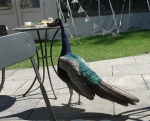
First the café was disappointing and clearly unprepared for the crowds that were that day enjoying the sunshine in this very lovely sculpture garden, though fortunately a peacock was able to peacock's tea, grabappreciate the facilities. As we were sitting  outside in the sun and out of the wind, we were plagued by wasps until we persuaded one of the staff to provide a jam jar trap.

The other disappointment was in Jupiter’s stated ambition to get every schoolchild in Scotland to visit free of charge. This may not have been intended to be exclusive, but it did appear to have more than a whiff of racism about it. Obviously, many schoolchildren in Northumberland live far nearer the park than those from further north in Scotland; and I can’t imagine an equivalent attraction in the north of England making entrance free for ‘English schoolchildren’. However, having browsed the Jupiter website, I think I’m satisfied that English schools would not be penalised; but while we are still one nation, I think it would be better to make it clear that the aim is to get as many children as possible to visit, regardless of where they live.

For me, the very best part of the whole lovely visit was the earth sculpture called ‘Life mounds’, by Charles Jencks, the artist who also created the rather smaller ‘Landform’ outside the Modern Art Gallery in Edinburgh some years ago. The one at Jupiter is extensive, with hills, paths and lakes, all of which can be explored. I found the experience of wandering around this installation inspired the same contemplative attitude as many labyrinths do, and I could have stayed there for hours, soaking up the peaceful atmosphere.Life mounds 3

Life mounds 2 Life mounds 1

3 Comments

Under the microscope

Micrographia workshop in Exeter Cathedral Library

I don’t often get the chance to attend someone else’s workshop, but when I saw this one advertised I jumped in fast. What a treat to be given the opportunity to learn more about science and the natural world, and to hear, write and share poetry.

The workshop took place this morning at Exeter Cathedral Library, where we started by looking  at and learning about Robert Hooke’s ‘Micrographia’ of 1665, and playing with lots of microscopes, before settling down to write some poetry. There was room for only ten people, so I was glad I booked early.

Robert Hooke was an amazing polymath: natural philosopher, botanist, inventor, architect, astronomer and much more. We owe him (among other things) Hooke’s Law and the term ‘cell’ for describing biological organisms.

open bookBut today our interest in him was predominantly for his magnum opus, ‘Micrographia’, which was on display for us to inspect and handle.

To the King


Felicity Henderson of Exeter University co-ordinated the event; and Mark Ramsdale and Katie Solomon from the university’s Biosciences Department kindly brought along a dozen or so microscopes of different ages and magnifications for our use. These ranged from a replica of Hooke’s original instrument (the actual one being in an American library) to very modern all-singing-all-dancing models.

We also had access to scores of tiny 19th century glass plates, all labelled in copperplate writing. Inside these plates were imprisoned the plant, animal and insect specimens that we then studied under the microscopes, delighting in our access to such a miniature fairy-tale world.

There were plenty of ticks, fleas, lice and other such delights; but my four favourite slides were the following:
A humming bird’s feathers illuminated in vibrant colours of puce, lime and purple;
Dragonfly wings which under the microscope were revealed to be made up of fine tracery, with tiny ‘stained glass windows’ at the edges;
Mould, which when magnified many times looked for all the world like a pleasant summer garden
Hooke_mold_1665_dar12506and (perhaps best of all)

nettle 1


nettle stings with their fine hairs and mini syringes to pump poison into our skin.

The ropes across the page below the nettle leaf in this slide are the beards of a wild oat.

Having subjected a full stop to his microscopic investigation, Hooke described what he saw as ‘like a great splotch of London dirt’. I think that image will stay with me for a while, and add interest to the normal procedures of punctuation.

The second part of the morning was given over to a couple of writing exercises, introduced by the poet Matthew Francis. The first exercise he gave us was to experiment with syllabic poetry, and he set us the pattern of syllables <13, 10, 7, 6, 5, 4>, which is a pattern he has used successfully for all the poems in his recent collection, ‘Whereabouts’. The other exercise used some extracts from Micrographia to inspire our own work.

It is always a joy to hear what other poets come up with in response to prompts and challenges, and although I didn’t feel that my first effort at syllabic poetry was particularly impressive, it has inspired me to experiment a little with this form. It was interesting that when Matthew joined us in writing to the prompt, the poem he came up with was far more balanced and polished – which rather suggests that once one gets accustomed to the form, it can flow as easily as any other style of writing.

microscope 3

6 Comments

Boats, bikes and beaches

My last blog covered the Guernsey Literary Festival, so I’ll just add that we had some wonderful View from lunchwalks when we were not at events. Here’s a picture of the scene before us as we ate our lunch one day.
I had rather expected to find the Channel Islands swarming with tax-evaders; but I’m pleased to say that, in my limited experience, that wasn’t the case. There were some gas-guzzling cars and certainly some quite vulgar large plush boats, but the people we met were perfectly normal, and most of the houses were quite modest. There were some beautiful sailing boats, but the rocks that surround the islands like sharp teeth were enough to persuade me that there are other waters in which I’d rather sail.

One small, rather sweet, peculiarity of the islands is that the post boxes are blue instead of red. Many of the road names are still in Norman French, which used to be the patois of the islands; but apart from that there didn’t seem to be a great deal of French influence, despite the sizeable number of French visitors. The only two less than perfect aspects of the whole holiday were 1. Channel Island coffee and 2. the fact that I was sea sick on the fast cat bumping over the Atlantic swell for an hour and a half on the way from Alderney to Guernsey at the end.

After the Guernsey Literary Festival, we took off to explore the smaller islands. This blog is to share my personal reactions to Herm, Sark and Alderney, which I’ll describe in the opposite order to our visits, so that I can end up with what, for me, was the best.

Alderney is further from Guernsey than the other two and is, in fact, within sight of France. It is 3 miles x 1.5 miles and has a population that has recently dropped from 2,000 to about 1,900, most of whom live in the only town, St Anne.

???????????????????????????????The boat in which we should have travelled from Sark to Alderney turned out, to our surprise, to be out of the water, so we had to take a ferry back to Guernsey and then fly to Alderney. As we approached the island we flew over two rocky outcrops which appeared to be covered in snow. This is one of the largest gannet colonies, hom???????????????????????????????e to about 2% of the world’s population of gannets. The next day we walked out to the cliffs just above the gannetry, and lay in the sun, surrounded by sea pinks, as we watched the endless comings and goings of the birds (well, clearly some watched more than others!)

We were delighted to discover that we had arrived just as the Alderney Performing Arts Festival weekend began. On the first evening we went to a performance by the Bowjangles: a professional string quartet of comedians, who both play exquisitely and also fool around and raise laughs. It’s one thing to watch someone with a violin leaping on and off chairs, playing imaginary tennis with the instrument or using it as a weapon; it’s another when the instrument is a ‘cello. The ‘cellist had a small lump on the neck of her instrument that slotted behind her own neck, thus enabling her to dance and cavort without dropping her instrument.

???????????????????????????????

The following morning the festival was moved up a key – or rather several decibels – with a procession of Samba drummers through the town. Then that evening we walked out to Essex Castle for a beautiful performance for harp and singer-dancer of Christina Rossetti’s ‘Goblin Market’, followed by supper. The harpist was Elizabeth-Jane Baldry from Devon, and the singer-dancer was Maxine Fone, who had me completely mesmerised throughout her performance.
Down on the beach near the harbour there is a temporary sculpture, known as the Alderney Man, created by the sculptor from Bath, Anna Gillespie. Unfortunately, I believe that this will be removed later in the summer.

Alderney was evacuated during WWII, and therefore completely taken over by the Nazis. It is impossible to forget this sad history, as the whole island is bristling with military installations – some of which, in fact, pre-date the war by several centuries.

The best aspects of Alderney were the coast path, the butterflies, the birdsong and the cobbled streets (strictly sets not cobbles). There are said to be blond hedgehogs on Alderney, but the only hedgehog I saw had been squashed by a car so it was impossible to tell what colour it had been. I did however learn than baby hedgehogs are called hedgehoglets.

On the negative side, the island, and certainly the town, is ruined by too many cars driven by atrocious drivers. The pavements are very narrow, and drivers think nothing of parking their cars on them. Given the tiny size of the island it is crazy that such unnecessary traffic has been allowed to proliferate to this extent. The inhabitants of the island appeared to be more insular than on Herm and Sark, and the level of cuisine was lower than I had expected from somewhere so close to France.

Sark. Our time in Sark was cut short because the boat we had booked turned out not to be in operation. However, we spent a couple of pleasant days walking, ‘cycling and visiting ???????????????????????????????some friends (poetry again!)

There are two islands: the main Sark, and Little Sark which is connected to the main island by a high ridge called La Coupée, on which prisoners of war built a narrow (and rather high) path.

Sark is about 4.5 square miles, the population is a mere 600, and most people travel everywhere by bicycle, so it is great for walking and ‘cycling. Tractors are allowed on the roads, for transporting goods and people, and as is the way with such things, the number of these has increased exponentially. There are also horse-drawn carriages, but these are not suitable for the steep climb up from the harbour to the ‘town’. The town itself has wide, car-free dust roads and clapper board houses, which together give it something of an air of the Wild West.

The island forms part of the Bailiwick of Guernsey, but is self-governing. The strange, and rather archaic, political system is further complicated by the presence on the nearby island of the Barclay Brothers, who have tried to influence events and development on Sark and are consequently not universally popular. The politics of this tiny island would, however, need a whole blog to expound, so I’ll pass over the detail and just say that La Seigneurie Gardens, attached to what used to be the residence of the Seigneur, are beautiful.
La Seigneurie gardens

One of the changes wrought by the Barclay brothers is the introduction of vineyards, of which there are now probably half a dozen, all of which seem to have taken well. These, too, are not generally liked, and there is scepticism about whether they will produce good enough grapes for wine; but some project leading to export would seem to be of potential benefit.

Sark has been awarded a Dark Skies status, so the nights were truly black and star-lit. The island lacks the beautiful beaches of Herm, or even Alderney, but the cliffs are fairly spectacular. There is only one postbox on Sark, and this was painted gold, in honour of the dressage Olympian, ???????????????????????????????Carl Hester, who was born on the island (though I believe it is many years since he has lived there).

One of the highlights of our visit to Sark was, I must admit, the opportunity to have lobster for dinner two nights running, without breaking the bank.


Herm
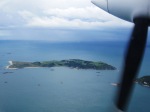
???????????????????????????????

Herm was, without doubt, my favourite island. It claims for itself the title of ‘Paradise Island’, and the nomenclature is not entirely inappropriate.

??????????????????????????????? We had secured a special out-of-season deal at the gorgeous White House Hotel, and were thoroughly spoilt for two glorious, ultra-relaxing days.

I think we covered every inch of the tiny island several times, which is hardly surprising as it measures a mile and a half by half a mile. There are no cars or bicycles on the island; but both round the coast and crisscrossing the interior are excellent footpaths. I believe that in summer the island does fill up, but with a population of 60, at this time of year it is extremely peaceful.

View ???????????????????????????????

There are beautiful beaches (and the hardier member of the family did actually indulge in one sea swim – while I saved myself for the pleasant hotel pool), and the whole island is covered in flowers.


At the north end, where the land is moor-like, the burnet roses were growing like daisies, and the daisies like grass.burnet rose burnet roses

If I ever get the chance to visit Herm again, I shall jump at it. The food was great and the staff were all friendly and relaxed, Our bedroom had a large balcony and looked out over the sea, where I could have sat dreaming in the sun for hours if we hadn’t been enjoying the walking so much. It would make a wonderful place to write, but I’m afraid that treat would be reserved for someone who had produced several best-sellers and could afford the luxury. I just count myself lucky that I was able to enjoy two such perfect days there.

???????????????????????????????


When we returned to Guernsey at the end of our holiday, we caught a ‘bus up to the Fresia Centre, where flowers are cut throughout the year and sent far and wide.


This was a really enjoyable and relaxing holiday. I hope I’ve been able to convey some of the experience to you in this blog.


4 Comments

Boats and buses

At the Guernsey Literary Festival

I’ve wanted to visit the smaller Channel Islands for years, which is why I entered a poem in the Guernsey Literary Festival competition this year. I reckoned that if it got anywhere, that would provide a good reason to catch the ferry and come. So here I am! The prize-winners’ reading was at Queen Elizabeth College at the top of the town, with a good variety of poems. But the real charm and excitement of this particular competition is that the successful poems will be displayed on the islands’ buses for the coming year. Because of this, the poems had to be short and succinct enough to fit on a poster inside a bus and still be large enough to be easily read. image

My poem, ‘On the way to somewhere else’, reflects on the feeling on a busy motorway that with so many vehicles heading in both directions, there is something to be said for all staying where we were. The poem was written while we were settling down for the night in our camper van in Cheshire last year.


It was good to spend some time with two poet friends from the Devon Company of Poets who were also among the prize-winners: Chris Considine and Denise McSheehy. image         image And the over-all winner of the competition was another old friend, Pat Winslow, her poem, Atlantic, about swimming in the waters of the Scilly Islands. image With Mediterranean weather and miles of beautiful coast path, it was natural that we should spend the day out hiking – and return with an impressive tan, in time for the reading by Andrew Motion, who read his poetry, talked about his life and writing and told us about his three sequels to Treasure Island – one of which has been published, another is coming out in October and a third was begun the previous day.image This was followed by the festival party at the Duke of Richmond Hotel, with canapés and exotic drinks flowing as freely as the currents swirling round the rocky coast.

As usual with such festivals, there was a tremendous amount going on, and it was not possible to get to more than a fraction of the events. One very interesting venue was Cornet Castle, built on a rock in the harbour. On Friday evening this labyrinthine series of buildings was taken over by the festival, with bands, readings, free entry to the museums, food and a host of activities for children. Consequently the whole place was buzzing, and the whole population of Guernsey was aware of the Literary Festival.

Mario Petrucci was giving a reading on the battlements, but unfortunately I had been given the wrong time for this and turned up five minutes before the end. Mario, with his normal courtesy and generosity therefore insisted on dismissing his audience at the end of his reading, then sitting me down and giving me my own private reading. Sitting in the warm evening sun, high above the sea and surrounded by ancient battlements, and being read to by this wonderful poet was a magical experience. image

It’s not as easy doing blogs on an iPad as it is on my computer – but I think I’ve managed.image

4 Comments

Poetic Junketings

It’s a common perception that poets spend all their time scribbling away in lonely garrets. Well, some of the time that’s true, but we also love a good social occasion; and you’ll find that groups meeting to workshop their poems, as well as festivals and readings can all be fairly uproarious affairs.

One of the highlights of the social year for poets is the annual gathering in the Ballroom of the Savile Club in London, when the winners of the National Poetry Competition and the winner of the Ted Hughes Award are both announced and invited to read to the assembled company of literary glitterati. Wine flows freely, we are constantly plied with canapés, we applaud the fortunate winners, meet up with old friends and make new ones. It all makes for a very jolly evening.

This year I was particularly struck by how far the Poetry Society has travelled in the last few years. The sticky period is now well in the past and there is a wonderfully positive and Judith Palmer 5supporting atmosphere. Much of the credit for this goes, of course, to Judith Palmer and her excellent staff. They have worked tirelessly to bring off an amazing transformation and are to be congratulated not only on the way they have put right things that were wrong, but have also launched out into new and exciting endeavours.

The Ted Hughes Award was set up by Carol Ann Duffy when she became Poet Laureate, and
Carol Ann 4generously offered to donate her annual honorarium from HM the Queen to fund the £5000 prize each year. It is a little different from other prizes, honouring both excellence and innovation in poetry. This year the prize was won by Maggie Sawkins for her multimedia live literature production, ‘Zones of Avoidance’, which explores and reflects on her daughter’s descent into drug addiction.

You can read some of Maggie’s poem on the Poetry Society website; but here’s a taste:

I’m reading ‘The Confessions of an English Opium Eater’ – Maggie Sawkins reduced 4
I want to understand what drove my daughter out in the snow

with no coat or socks, in search of a fix.
I want to understand what divinity led her

to set up camp in the derelict ‘pigeon house’
after running out of sofas to surf.

For those of us who write, our writing is often a way of trying to make sense of experience, attempting to understand ourselves, other people and the world as well as to celebrate it.

Linda France cropped 6Congratulations, too, to Linda France, who has won the 2013 National Poetry Competition for her poem ‘Bernard and Cerinthe’. With well over 12,000 entries, the winning poem is likely to be a bit special, and Linda’s poem certainly is. I’d like to insert an extract from the poem here, but it all hangs together so beautifully that it doesn’t feel right to take bits out. So buy the latest Poetry Review and read this wonderful poem in full. Congratulations should also go to the three judges, Julia Copus, Matthew Sweeney and Jane Yeh who undertook the mammoth task of reading all those thousands of poems. Obviously judging poetry competitions is always subjective, but it is impressive that these three were unanimous in their choice of first prize.

Two prizes of £5000 each on one night makes it sound as though poets get a cushily life; but the reality for the vast majority of poets is that, apart from a trickle of financial reward from publications, small competition wins and readings, love and satisfaction are the main rewards they are likely to reap for their all-absorbing commitment to writing. But on an evening like the one I’m describing here, there’s also the fun of being part of a lively and talented community and spending an evening with like-minded people for whom poetry matters immensely.

1 Comment

Words by the Water 5


After a busy, but relaxing, holiday in the Lake District, attending events at the Words by the Water Festival, I’ve returned to a mountain of urgent work; so this final blog of the festival will of necessity contain slightly less information about the talks and readings than some of the earlier ones.

Claire Langhamer & Paul reduced

To continue where I left off last time, on Friday morning Claire Langhamer (pictured left with Paul Brassley) talked about The English in Love, quoting such diverse sources as Agony Aunts and the Mass Observation Archive of 1937.

I then moved on to a session on George Eliot’s Middlemarch. Rebecca Mead 1 reducedWhen I was booking tickets, I was somewhat surprised that this event was the one that nearly sold out on the first day. Rebecca Mead, who is now a journalist on the New York Times, was interviewed before a capacity audience in the Studio. She outlined how her early life followed, to some extent, a similar pattern to that of George Eliot’s, as she escaped a small rural community (in Rebecca’s case by going up to Oxford). Middlemarch was initially serialised, and Mead shared an amusing anecdote about a bishop at the time being discovered at a conference reading the latest instalment of Middlemarch which was tucked into the hat on his lap.
Lynn Segal 1 reducedWe had received news by this time that Melissa Benn was unable to share the session on  ‘Ages of Feminism’ with Lynne Segal because her father was very ill. We were therefore not over-surprised, though we were extremely sad, to hear that morning that Tony Benn had died. Lynne Segal was up to the challenge of filling the allotted hour, and she spoke movingly about the disappointment of observing the state of our country and politics now, after both Socialism and Feminism had fought so hard for something better.

Jeremy Hardy 2 reduced

I had not heard the comedian, Jeremy Hardy, before, and enjoyed his event, ‘Not Raving but Frowning’, that evening. I reserve the right to suggest that the ‘f’ word was used rather too frequently and often unnecessarily; but the act was very good and Hardy came across as a delightful, sensitive, politically acute and very funny person.

The subject of Linda Colley’s talk, ‘United Kingdoms’, has a special interest in this year when Linda Colley 2 reducedpart of our United Kingdom is at risk of secession. Colley guided us back through some of the landmarks of our various unions: 1536 – between England and Wales, 1603 – James VI of Scotland becoming James I of England, 1707 – Parliamentary union, 1800 – GB and Ireland, 1922 – United Kingdom and Northern Ireland. She pointed out that all of these unions took place in periods of war, whereas times of peace tend to produce calls for reorganisation and separatism. She also reflected on the present increasingly obvious North-South Divide; and there was some discussion with the audience about the possibility and value of Regional Assemblies.

Paul McMahon reducedOn Saturday afternoon, Paul McMahon spoke on the subject of ‘Food Glorious Food’, based on his book Feeding Frenzy in which he addresses the question of whether it is possible to feed the world’s population as it rises to nine billion by the middle of this century. He assured us that there is enough land and enough water to allow sufficient food to be produced. At present one in eight people on the planet is hungry and one in five is obese; there is land degradation, flooding and erosion; the prices of raw commodities are rising, and consequently so are food prices; in the US, 40% of the grain crop is used for biofuel; there is growing competition from the East, and speculation causes problems. McMahon advocated 1) helping small farmers in poor countries, 2) putting ecology at the centre of food production, 3) making financial markets work for food security and 4) learning how to ‘love’ high food prices. I was disappointed that no mention was made of vegetarianism. It has been acknowledged since at least the 1960s that if people would reduce their consumption of meat, there would be easily enough food to go round.

Germaine Greer reducedI had heard Germaine Greer lecture before and been impressed by her, so went to her talk on ‘The Rainforest Years’. Greer was not as incisive as last time I heard her, but it was interesting to hear a little about her work to restore a sixty hectare area of Queensland in Australia, which she took on as a challenge and as something where she could have an effect. Greer’s love of and knowledge of zoology, and her passion for the environment, are both impressive.

Colin Tudge 2 reduced

On Sunday morning Colin Tudge spoke on the subject his latest book, ‘Why genes are not selfish and people are nice’. I’ve done a little work in this area myself, so was keen to hear what Tudge had to say. Tudge has been involved in the Campaign for Real Farming, and urges an enlightened agriculture. He also believes that life in all its forms is intrinsically cooperative, and that therefore cooperativeness is the best survival tactic.

I would like to have stayed in Keswick to hear the talk on ‘Malala’ later on Sunday afternoon, but it was imperative that I got home that night so I had to give that one a miss. The last presentation I was able to attend at the festival, therefore, was given by Pedro Ferreira on ‘Einstein, Relativity and Perfection’.

Pedro Ferreira 1 reducedIt was good to end on a real high. Ferreira, who is a Professor of Astrophysics at Oxford, is another of those wonderfully bright academics who are such a joy to observe and listen to. He was bubbling with excitement about the news that was going to break the next day about Gravitational Waves – predicted by Einstein 100 years ago – and he explained something of the research and discovery to us. In a talk ranging over General Relativity and our modern understanding of gravity, Quantum Mechanics, Dark Matter and little green men, I suppose this highly personable Portuguese scholar was bound to lose me from time to time; but he never made his audience feel stupid, or risk losing our attention.

Congratulations to Kay Dunbar and Stephen Bristow on another great festival. We thoroughly enjoyed the events, and also revelled in our wonderful position on the shore of Derwentwater and our daily walks to the theatre. The scenery changed every day: we watched as the snow on the mountains gradually diminished, we observed the lake water encroach on our van in the storm and then return to its proper bounds, we ate outside when the sun shone, saw enough daffodils to keep Wordsworth happy for many a year, and we enjoyed spending time with lots of old and new friends.

photo

3 Comments

Words by the Water 4: a brief visual interlude

As I shall be without internet access for the next couple of days, my final blog on this year’s Words by the Water will not be posted until I return to civilisation.

So, by way of something different, here is a small taste of some of the beauty we’ve encountered outside the portals of the Theatre by the Lake this week.

Snow on mountains reduced

wood hand sculpture reduced

lichen 1 reduced???????????????????????????????

tree cup reduced

silver birch reduced

Radical reduced

Keswick church & fells reduced

Large stone at Castlerigg reduced

Lake view reduced


Little daffodils reduced

misty lake reduced

H beside Windermere 1 reduced

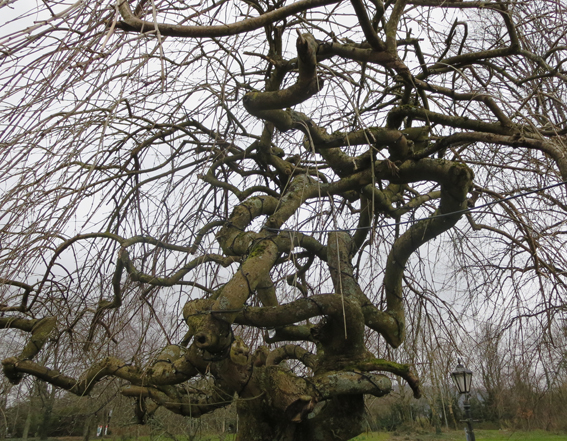
gnarled tree reduced

1 Comment

Words by the Water 3

Derwentwater reduced

After the storm on our first night here — with six inches of rain overnight — we’ve been enjoying fantastic weather for the last few days, with nearly all meals now taken outside. Also hugely enjoyable were the two talks by amazingly bright and charismatic speakers on Tuesday: Tom Holland and George Monbiot.

Tom Holland (pictured here with Stephen Bristow) has recently translated the whole of Herodotus, so his talk was entitled Herodotus Tom Holland & Steve reducedand the Ancient World. His portrayal of Herodotus, the first historian, as a precursor of Google might have been a little fanciful, but in terms of following threads within the Histories, going off at tangents to investigate and pursue something of current fascination and skimming to find the bits of most interest, there were certainly some parallels.

Herodotus was writing between 440 and 430BC, and he lived in Ionia, in modern-day Turkey. His stories of the Persian Wars were what first attracted Holland to him at the age of 11, and Holland has loved his work ever since. It took him six years to translate the Histories, taking one paragraph every day without fail, regardless of holidays or any other excuses for not writing.

I must admit to being a fan of George Monbiot’s, so was delighted that he was featuring at the George Monbiot 3 reducedfestival. From the applause at the end of his talk it was evident that I wasn’t the only one to appreciate his entertaining and informative lecturing style, his wide-ranging interests and his quirky sense of humour.

George was talking about his recent book, Rewilding: the talk began with elephants, proceeded through hedge-laying, upland farming and the ‘shifting baseline syndrome’ and took in  a range of megafauna, farming subsidies and reforestation. His main thesis is that we should be returning the country — or at least a good part of it — to forest, and that the (beautiful) bare fells of the Lake District, with their attendant extensive sheep-farming, are bad for the environment. He would also like to re-introduce some to the species of fauna that we’ve lost, such as beavers and pine martens. I hadn’t realised before that the presence of pine martens can actually increase the incidence of red squirrels. Apparently they were introduced into Ireland some time ago, and as they chase squirrels, the greys cannot get away from them while the lighter, more agile, reds are able to find protection at the ends of branches; so the greys are diminishing while the reds are increasing.

Monbiot’s message, which was characterised by hope rather than pessimism, is one of positive environmentalism. There were Lakeland farmers in the audience who were not happy about Monbiot’s approach; but Monbiot is a deep thinker who not only has something of a feral nature himself, but is also blessed with a huge brain, extensive knowledge and a charming manner, so while it is possible to dispute some of his ideas, I think we should all hear and reflect upon what he has to say.

We took the day off on Wednesday, and as the sun was beating down we decided to walk all round lunch at Mary Mount reducedDerwentwater. It’s a distance of a little over nine miles, but there’s a good spot for lunch half-way round where, yet again, we were able to eat outside. The terrain has been improved since the last time we trekked round the lake, so the walking was not difficult, and it was certainly a day for shorts and tee shirts. We were surrounded every minute of the day by so much beauty, both in the countryside through which we passed and also in the individual trees, flowers and lichens that we stopped to admire on the way.

David Leigh reducedWe still had the energy to return to the theatre for the evening where we had a lecture about WikiLeaks by David Leigh, the former Guardian correspondent who co-authored the book about WikiLeaks with Luke Harding. This was followed, after an interval, with the film The Fifth Estate, which was a dramatised portrayal of the phenomenon of WikiLeaks and of its instigator, Julian Asange.

Richard Harries reducedMoving on to Thursday evening, I went to hear Richard Harries, the former Bishop of Oxford, talk on the subject of his latest book, Modern Art: A Friend of Christianity? I’ve lectured many times myself on the subject of religious art, so was interested to to hear what he had to say and to see which works of art he chose to show. One of the attractive features of his presentation was that he allowed us some silence in which to engage with the pictures, instead of talking the whole time. We were treated to a wide range of artists to support Harris’s thesis that modern art is the friend of Christianity rather than its foe.

The final lecture of the day was a tour de force by Simon Thurley, author of The Building of England, who guided us through a Simon Thurley reducedhistory of England through architecture. He describes himself on his website as ‘an historian, archaeologist, curator, writer, broadcaster, museum director and heritage crusade’ and he appears to be an expert in each of these fields. He is now Chief Executive of English Heritage. Instead of tracing the history of architecture through chronology, dynasties or styles, Thurley does it through the people who built and used the buildings: what they built, why they built them, and what the buildings tell us about those people. Rather than an exegesis on columns, then, or the appropriate names given to stylistic changes, we had flying shuttles, steam engines, fire grates, the Black Death, the rise of Britain’s (especially London’s) dominance in the world and population decline and increase — all absolutely fascinating, and delivered with verve and panache.

It is impressive how Kay Dunbar and Stephen Bristow manage to attract such wonderful scholars and speakers to their festivals; and it is a great privilege to be able to sit at their feet to listen and learn.


1 Comment

Words by the Water 2

The sun, happily, reached the north west on Sunday, so since then we have been able to sit beside the sparkling lake – which has now returned to its proper bounds – enjoying the peace. The snow on the mountain tops has still not disappeared, so I imagine it’s still pretty chilly up there. The only sounds are the rattling woodpeckers, the lapping of gentle waves and the honking of many geese. Sometimes the geese take off in noisy panic in the middle of the night – but we are certainly not short of sleep in this deep peace.

Michael Rosen 1 reducedThe first speaker at the Theatre on the Lake on Sunday was Michael Rosen who was talking about his book ‘Alphabetical’. This was hugely enjoyable: both informative and highly amusing. The session got quite noisy as the theatre kept erupting in laughter; but in between the hilarity he presented many gems he had discovered in the course of his research. The ground covered ranged over the Phoenicians, The Grimms Brothers, Beowulf, Yiddish and the Beaker people; and such was the enjoyment all round that Michael was not able to stop, nor the audience to tire, so he ran well over time. I tried to resist buying his (rather expensive) book, but when I saw a signed copy still sitting on the book stall the next day, my resolutions melted and it is now taking up room in the van.

Charlotte Higgins 2 reducedI had heard Charlotte Higgins lecture before, on Boudicca, so went to her session on ‘Under Another Sky: The Romans in Britain’. Quite a bit of the presentation was taken up with information about the archaeologist and scholar Robin Collingwood, who was born in Coniston, and Edward Williams Byron Nicholson, the librarian at the Bodleian Library at the beginning of the twentieth century. Charlotte also talked about, and showed slides of, the Tullie House helmet discovered in 2010, which is now in the Crosby Garrett museum. Unfortunately, because single bronze items were not covered by the Treasure Act of 1996, the helmet was privately restored before being put on the open market; and even to someone with no claims to expertise in the period, it was pretty clear that the restoration was something of a catastrophe.

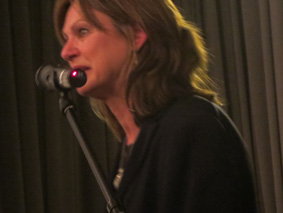
For my dose of poetry for the day I went to the reading by Don Paterson: ‘A Life in Poems’. Don Don Paterson croppedis a good poet, with a great flair for rhyme and a facility for sonnets and ballads. His strong Scottish accent allied to the soft acoustics meant some gems were missed, but it was an interesting and varied reading. I think Don probably revels in the image of a ‘grim Scot’, and there were not many giggles in the hour. His description of Dundee as so awful that in the competition for City of Culture it ‘lost to Hull’ did, however, raise a few laughs. He does not want to write in Scots as it is a dead language; and one charming piece of information I brought away with me was that there are 63 words for ‘coughing’ in Scots.

This year is the 100th anniversary of the birth of the Lakeland poet Norman Nicholson, who was born in Millom and lived in the house in which he was born for his whole life; so Sunday evening was taken up with a celebration of his life and work. Kathleen Jones has written a biography of Nicholson, ‘The Whispering Poet: A Tribute’, to coincide with this anniversary, and the talk with which she introduced the event was fascinating and charming enough to persuade anyone to buy her book.

Kathleen Jones 1 reducedKathleen showed the influence of Methodism on the poet’s development, the part played by various friends and relations, the effect of the two years Nicholson spent in a sanatorium when he contracted TB in his teens, and his passion for the environment and what would now be called ‘green issues’. After a short interval, Neil Curry, a local poet and friend of Nicholson, gave a reading and a talk for a further hour, with more information about Nicholson. Given that we’d already had nearly an hour on the poet, this second talk could, perhaps, have benefitted from being a little shorter – though Currie offered us plenty of interesting material and it was good to hear some of the poems.

The evening finished with a video extract from a 30-year-old South Bank Show on Nicholson which showed Nicholson reciting some of his poems — not to mention an extremely young-looking Melvyn Bragg introducing the programme.

Ewan Clayton 1 reducedI attended only one event on Monday: Ewan Clayton, the calligrapher, talking about his book ‘The Golden Thread: The Story of Writing’. An enthusiastic speaker with a wide range of experience and expertise made for a fascinating lecture which covered handwriting, Xerox, typewriters and fountain pens. Among the nuggets I brought away with me were the following: in 2012, there were 6.1 billion mobile ‘phone subscribers; 14 million bic pens are sold daily; fountain pen sales increased by 50% last year; in the light of recent security breaches, typewriters, instead of computers, are increasingly  being used for top secret intelligence; and it’s predicted that in 2017 50% of all computers will be tablets. Ewan was optimistic about the future of handwriting, and suggested that we should be using all the tools at our disposal, rather than favouring one or other.

A at Castlerigg 3 reduced

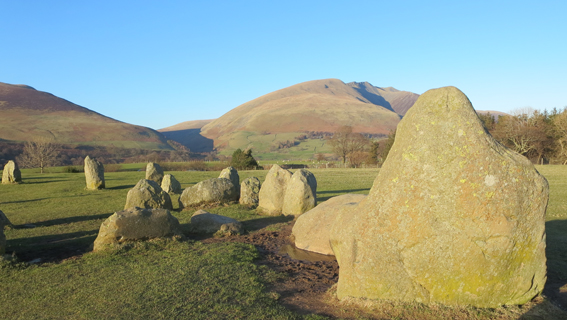
Then it was off to enjoy the more active delights of a Lake District bathed in warm sunshine. We walked up to the Castlerigg Stone Circle, which is reputed to be the oldest stone circle in Europe, dating from over 3000 BC. It is certainly beautiful and has a wonderful atmosphere, set on a round flat plateau and encircled by mountains.

If you look carefully, you’ll see the snowy peak of Helvellyn peeping through from behind the other hills.

Castlerigg stone circle 3 reduced

2 Comments