I was really pleased to be invited to be part of a delegation of British poets visiting Romania in April. Part of my delight was because, although one of my daughters went there as a volunteer to help in an orphanage when she was a student, this was a country about which I knew 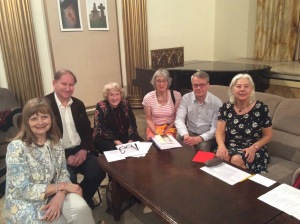 far too little. The other part of my delight was because I recognised that with such a lovely group of poets we were bound to have fun. The other poets were Maggie Butt, Katherine Gallagher, Jeremy Page, Peter Phillips and Anne Stewart. I had published Maggie and Anne as Oversteps poets, and was well aware of the fine reputation of the others.
The visit was arranged by Lidia Vianu of the University of Bucharest Masters programme in Translation, and as the department was celebrating its tenth anniversary, celebration was in order. The idea was to spend four hours on each weekday morning at the Romanian Cultural Institute, working intensively with a group of students, and then to have a wide range of visits and special events in the afternoons and evenings.
 I was allocated 13 students and thoroughly enjoyed my time with them. For the second year students’ final assessment they had been translating Romanian poetry into English, and our task was to help them ensure that the English was perfect. One of the poets had used strict forms, mainly sonnets and rhyming couplets, and I occasionally felt there was a risk of losing some of the poetry by slavishly replicating the rhyme patterns, so some careful judgements had to be made.
 Early in the week we were invited to a reception at the residence of the British Ambassador, Paul Brummell, who gave us a delightful evening, introduced us to a number of dignitaries and also delivered an intelligent and relevant talk.
At the end of the week the six of us led a discussion on Shakespeare at the British Council, and then gave a reading of our work.
 In between these two events, in just 72 hours, an anthology of our poems was translated into Romanian, edited and published ready for distribution at the final event. The
 book was called simply ‘Six British Poets’. Our poems were translated by Ioana Ieronim, and published by Integral Press, Bucharest. I’m pictured here with Ioana, the translator.
In between these two official engagements, we had an enor mous amount of fun, and were looked after royally by our hosts. We had a memorable dinner at ‘Lacrimi si Sfinti’, the restaurant belonging to Mircea Dinescu. Mircea is one of the best-known Romanian poets, was very much involved in the Revolution against Ceausescu in 1989, and now owns a farm out in the country where he grows all the food
  and wine for his fantastic restaurant in Bucharest. Here he is pictured with his wife, Maria; and in the other picture you can see the band that entertained us as we ate.
Other highlights of the week included visits to various museums and to the Parliament Palace, the strange, over-sized palace constructed by Ceausescu, which he did not live to inhabit as he was executed more or less as the building was completed. No expense was spared in this palace, and although it may not be to everyone’s taste, it is certainly impressive.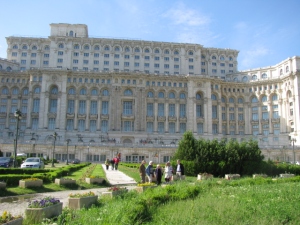


We were all grateful to the generous funders, who contributed in various ways to make our visit so successful: the Romanian Cultural Institute, the University of Bucharest, the British Embassy and British Council, the Writers’ Union, the National Literature Museum and the Government. We also made many good new friendships while we were there, and were very happy when Elena Nistor, who guided us around many museums and other places of interest during the week, invited us to lunch at her mother’s on the final day. Another rich experience was spending half an hour at a service in one of the many beautiful churches on the Orthodox Palm Sunday.
Above all we are deeply grateful to Lidia Vianu, who runs both the MA in Translation and also  the Contemporary Literature Press, for organising such an amazing week for us, and looking after us so well. She, and others, are now engaged in producing another book, which will include some of the work done by the students, as well as more of our poems.
A final comment about Bucharest itself: as well as being impressed by many of the older buildings we saw, we were thrilled by the presence of so many trees, both in parks and along the roadsides. It was because of the presence of so much woodland that we had the pleasure of hearing birdsong each day, even within the confines of the city.
Comments closed

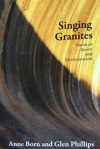 wonderful welcome in Perth. Glen was the joint author with my predecessor, Anne Born, of ‘Singing Granites: Poems of Devon and Gondwanaland‘, which was the second book I published after I took over as Managing Editor of Oversteps Books






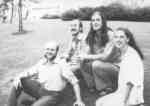 nald, a fantastic jazz saxophonist and flautist; the actor and musician, Gus Garside; poet and crystallographer Robin Shirley; and me. I was lecturing in Philosophy at Surrey University at the time, but was also a poet and musician. The biographical notes that appeared in the programmes for some of our performances are at the bottom of the page, below the sample poem.
 hen came out, and for each phrase we had to determine what the probability was of its occurring, and the possibility we wished to allow for that phrase to be repeated. The skill, obviously, was in choosing the best phrases to feed in; and some of the results were strikingly good. The computer programme we used was devised by Robin using the ICL 1905F computer at the University of Surrey.
 and was followed by Bard 1D and Bard 2S.


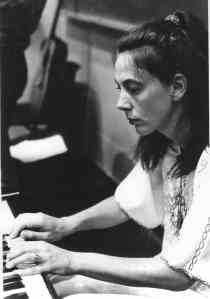 her works during our time together, including ‘Pavan for the Children of Deep Space’ and the extended group of poems in the popular suite ‘The Wheel of Seasons’. We then took all these works and jazz improvised to them, using sax, flute, guitar and bass guitar, keyboard, voice and various percussion instruments. It was all good fun.


 I had an interesting three days this last week, with Everyman at the National Theatre neatly sandwiched between a gig in which I was to be found playing the cornet as I marched down Kingsbridge Fore Street accompanying the townspeople as they danced the Floral Dance, and an open air performance of The Taming of the Shrew by Guildford Shakespeare Company. A
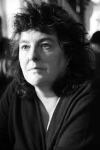 ll three were hugely enjoyable, but this blog is about the National Theatre production of ‘Everyman’ on the middle evening. The play is based on the mediaeval morality play, updated with a script written by Carol Ann Duffy.
 reography, sound and visual effects, could have been cut a little: we really had got the message by half-way through the sequence; and occasionally we lost some vital words and therefore missed a joke or punchline. But all in all it was a wonderful evening, with fine dialogue, and exciting sound and visual effects, including a terrifyingly realistic tsunami.
 God (still sweeping and cleaning) is heard to comment on how she still loves him, which is a religious message if ever there was one. But apart from that, the splendour of the performance and the strong environmental message, the play reflects in the cast and the production the rich diversity both of London, and of life.


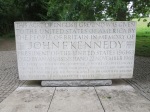 as designed by Sir Geoffrey Jellicoe. Part of the inspiration for his work is said to have been Bunyan’s Pilgrim’s Progress, and the experience of climbing up to the monument had a contemplative feeling. I found myself reflecting, sadly, not only on that crazy death, but on so many other areas of violence and killing in the world today.
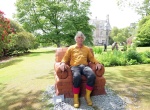 Delamore House is on the edge of Dartmoor, and is of special interest to us because it used to be owned by the same family as lived in the house that now contains our apartment. Although it is considerably grander (our house was the family’s ‘summer house’), there were similarities and common features, including a tholos, or cromlech.